On this page
Memory, working context and ongoing projects
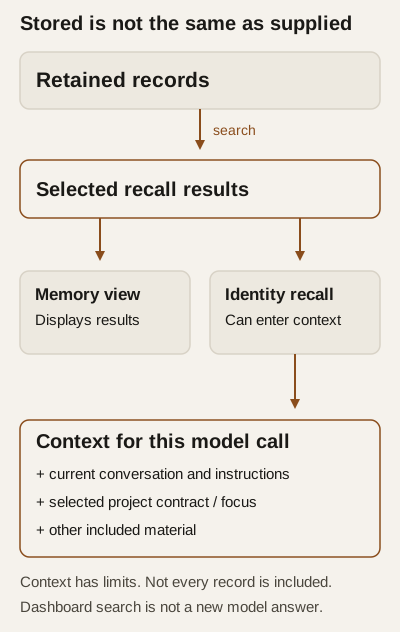
Concept diagram — how retained information and selected project state can contribute to context.
Stored does not mean present in every response
The memory screen initially loads selected state: beliefs, intentions, recent experiences and a self-model synthesis. Filtering those cards is different from invoking recall. The dashboard's Enter action calls the host recall handler, which invokes the identity's recall operation without asking a language model to compose a new answer. Embedding calls may still occur.
Recall searches indexed stores, including conversation and identity material. Word matching, fuzzy spelling matches and optional vector similarity contribute to retrieval. Results are bounded and ranked; the response reports source coverage and meaning-layer availability. A similarity score says how this embedding model relates texts, not whether a memory is true. Recall also attempts to reinforce returned memories, affecting later retrieval strength; it is not purely a read-only inspection. The loaded experience cards and ordinary experience search exclude private-marked experiences; that exclusion is not encryption or a promise that every retained copy is inaccessible.
Embeddings are numerical representations for similarity search. The chosen source embeds search cues and in-scope stored text; background backfill can be incomplete or delayed, including while voice is active. Re-embedding may occur when the model changes. Local dashboard execution therefore does not establish local-only processing. Disabling meaning search does not disable the conversation model. See what a conversation sends.
A workroom is not a running worker
A project keeps a directory and a project.json manifest containing its description, contract, focus and evidence observations. Its outcome describes what is sought; acceptance criteria state what could settle it; constraints bound the agreement. A parent link groups projects without creating a different kind of object.
The selected open project's contract and focus are included when the host builds working state. Work sessions have their own stored state and result, and can be attributed to a project. Switching or dropping focus is different from delivering a session, satisfying an acceptance item or closing a project. A stale focus can accurately preserve an old plan while being wrong about what should happen next: inspect evidence before resuming it.
Progress is derived from evidence observations, not a manually saved status label. Worker reports and local completion support an item but do not satisfy the verified tier. Verification needs a reference; explicit waivers need reasons. Changing criterion wording can make earlier evidence stale. These checks regulate recorded closure, not the truth of every claim.
Human controls and identity operations
Humans can filter/recall through the memory screen and create, select, edit, close, archive and unarchive projects through the traced UI. The identity uses recall for retrieval, note to append an experience to its signed record, and work project operations for create/update/select/deselect/close and evidence/waiver recording. These are identity tools, not commands to paste into a terminal. Asking for an operation does not establish it ran.
An experience note is not the same event as saving a conversation message. Project manifests and work-session storage are also distinct from those experience events. Neither hiding a project nor dropping its focus erases that history. This draft supplies no general memory-deletion procedure and no guarantee of removing information already sent to a provider.
Try the privacy-aware task guide