On this page
What happens in a conversation?
A message in the dashboard, information sent to a model, and information saved by AII OS are related, but they are not the same thing.
Imagine asking, “Help me make a short learning plan.” This is an illustrative request, not a captured conversation or a claim about the reply you will receive.
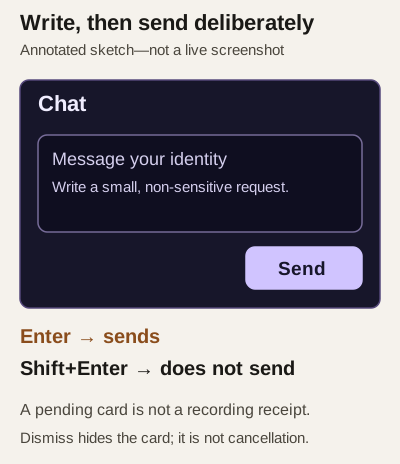
Annotated control sketch — source-derived, not a live application screenshot. Follow the adjacent steps and provider-specific prompts.
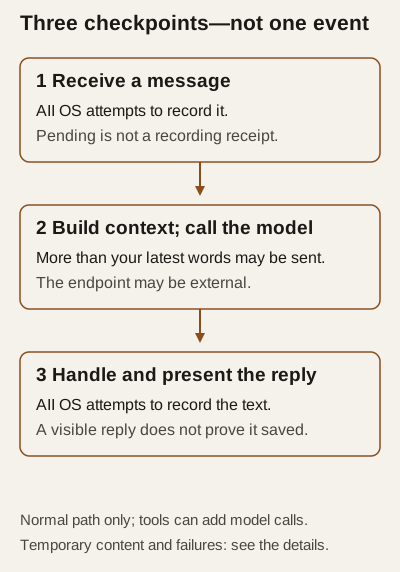
Diagram — the normal conversation path. Optional tool calls and error paths are in the text below.
Part 1: Sending is not the same as saving
The dashboard can display your message as pending before its recording is confirmed. Acceptance means the host admitted the request; it is not a recording receipt or proof that a model has answered.
In the normal recorded path, AII OS attempts to save the incoming message before requesting a model response. If that recording fails, this ordinary chat path stops before inference. In safe mode, the application can instead retain a temporary session copy and continue; that copy is not a saved conversation entry.
If the interface reports an unconfirmed delivery or recording failure, do not assume either success or absence of an effect. Keep the text and inspect the reported state before deciding whether to send it again. This page is not yet a tested recovery procedure.
Part 2: Your latest message is only part of the model request
AII OS builds a context for the selected model. Depending on available state, that context includes identity instructions and boundaries, selected identity information, working state and a bounded window of conversation history. It also supplies the tool definitions available for that turn.
For the learning-plan example, the model can therefore receive more than the sentence you just typed. Earlier retained context may also be sent. A persistent record is not perfect recall: the request has a size limit, and history or other context can be shortened or omitted. Information being absent from one request does not, by itself, mean it was deleted from storage.
The request goes to the configured model endpoint. A dashboard running on your computer does not establish that model processing stays there. With an external endpoint, the composed context leaves for that service. Understand that destination, its data practices and possible charges before sending sensitive information. This source trace is not an audit of provider retention or of every network activity in AII OS.
Part 3: Some replies involve more than one model call
A model may return text or request a tool. AII OS passes requested tool calls to its executor; a request is not a guarantee of permission or success. Tool results can be included in a subsequent model request, potentially carrying retrieved material or action results to the model endpoint too. Results can be shortened to fit the context.
An ordinary exchange does not necessarily use tools. This diagram does not enumerate tool-specific destinations or effects. Those require their own capability and data-flow explanations; do not infer that a locally executed tool keeps its result local.
Part 4: Seeing a reply is not a guarantee it was saved
AII OS handles the generated text, attempts to record the reply and reports the outcome. If recording fails, the dashboard can still receive the reply text together with an error. Safe-mode or failed-recording content can appear in a temporary transcript. Visible and durably recorded are different states. Temporary session content is bounded; do not rely on it surviving a restart.
In the traced normal path, conversation messages are written to the interaction database. That path should not be confused with creating a signed identity-ledger entry. Neither a saved message nor a continuing identity record makes an answer correct, ensures perfect recall, or establishes consciousness.
Keep these distinctions
- Pending, accepted, recorded and answered describe different checkpoints.
- Saved context and context sent now are not identical inventories.
- A local interface and local model processing are different choices.
- A tool request, an executed action and a successful result are not interchangeable.
Return to Meet AII OS for the introductory vocabulary, or Understand AII OS for this route's current coverage. Continue with preparation, the composer reference or phase-specific triage. Those drafts remain source-checked, not live-verified procedures.
For the design trade-off and its limits, see Continuity is not perfect recall. It separates retained information, supplied context and correct use without treating persistence as proof of consciousness.